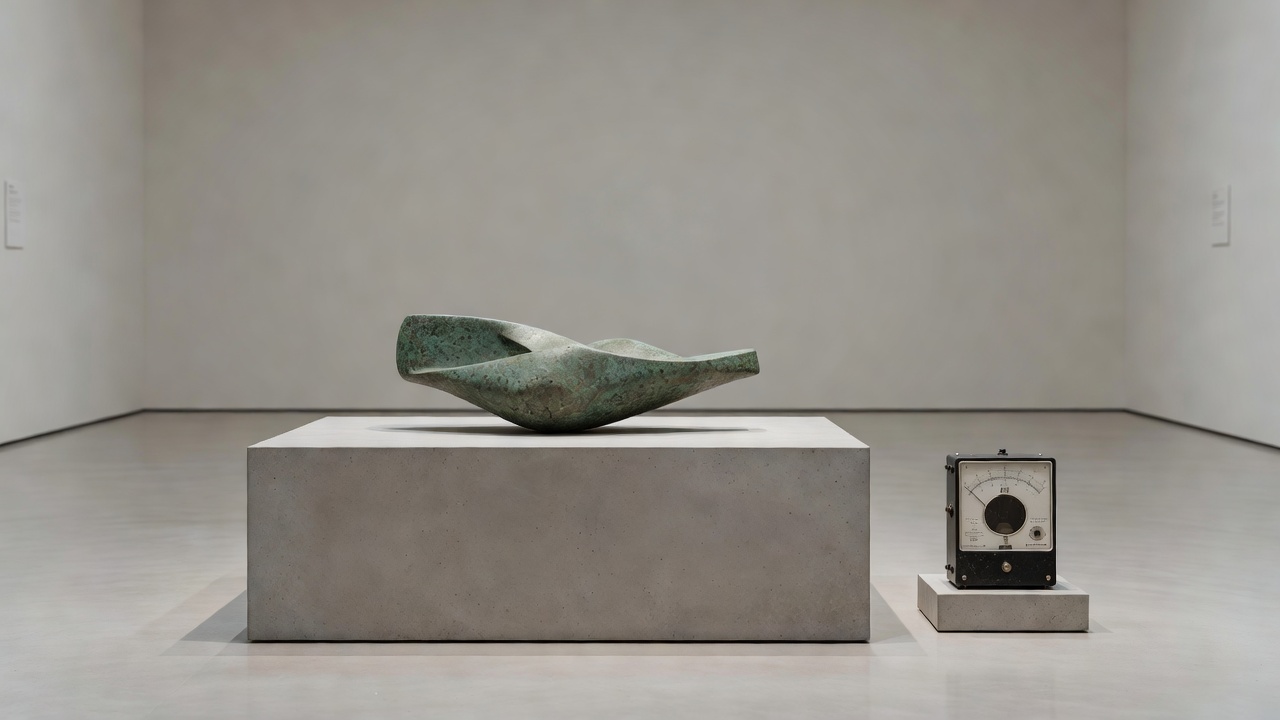
Light is an exposure, not only a reading
A light meter measures illuminance at a position and orientation, usually in lux. For collection care, exposure duration also matters. Integrating illuminance over time gives a luminous exposure commonly expressed in lux-hours. A low spot reading late in the day may miss strong morning daylight. Record where the detector faces, when it was measured and whether blinds, lamps or display arrangements changed.
Lux is weighted for human visual sensitivity, not for the damage response of every material. Two sources with similar illuminance may differ spectrally. Ultraviolet measurement adds useful information but does not make visible light harmless. Fading and other photochemical changes depend on material sensitivity and accumulated exposure. Establish a display strategy with conservation input rather than treating one meter value as permission for indefinite exhibition.
Air quality needs a specific question
Airborne pollutants can originate outdoors, from visitors and activities, or from the enclosure itself. Display materials may emit organic acids that matter to susceptible metals or calcareous materials. Other risks include oxidising gases and particulate deposition. A general “air quality” score does not tell you which substance is present, how much reaches an object or whether a relevant deterioration mechanism is active.
Optical particle sensors estimate airborne particle concentrations from scattered light. Their response depends on particle characteristics, and results may be influenced by humidity. Electrochemical gas sensors can have cross-sensitivities and require appropriate calibration. Broad volatile-organic-compound sensors provide indicators rather than a reliable identification of every compound. Match any instrument to its detection limits, uncertainty and the question being asked.
Sometimes a specialist passive sampler, laboratory analysis or materials assessment is more appropriate than a permanent electronic sensor. Sampling periods and blank controls matter. A low result over one interval does not prove that an enclosure is always benign, particularly after new fittings or adhesives are introduced. For sensitive objects, source control and careful material selection may be more useful than simply adding another chart.
Do not confuse occupancy with preservation safety
Carbon dioxide measurements can help investigate occupancy and ventilation, especially when interpreted with outdoor conditions and building operation. CO₂ is not a general proxy for pollutants that damage collections. A room can have an unremarkable CO₂ reading while a tightly closed case accumulates an internally emitted contaminant. The building scale and the enclosure scale deserve separate attention.
Likewise, counting airborne particles does not establish how much dust has settled on a fragile surface. Deposition observations, cleaning records and visual inspection can complement electronic measurements. Follow safe collection procedures: do not wipe or sample an object simply to validate a sensor. Some of the most important evidence is gathered through careful observation rather than continuous instrumentation.
| Signal | What it can support | What it does not prove |
|---|---|---|
| Illuminance | Local lighting assessment and exposure calculation | Absence of fading risk |
| Particle concentration | Investigation of airborne particle events | Exact composition or surface deposition |
| CO₂ trend | Occupancy and ventilation investigation | Safety from collection-damaging pollutants |
| Leak alarm | Water contact at the detector | Detection of every leak pathway |
Water requires a response chain
Leak cables and point detectors can provide valuable warning near vulnerable services or floor-level risks. Their effectiveness depends on routing, testing, power, communications and who receives the alert. A detector on the wrong side of a raised threshold may remain dry while water reaches a collection. Map likely pathways with facilities staff and consider drainage, storage height and practical access.
An alert must lead to a rehearsed action. Define who confirms the event, who can isolate services and how objects will be protected safely. Test escalation arrangements without exposing collections to water. Keep emergency procedures available offline: a network fault during a building incident should not make the response plan inaccessible.
Physical disturbance belongs in the picture
Accelerometers can investigate vibration during construction, transport or nearby activity. Interpreting their output requires attention to frequency, mounting, sampling and the object's support system. A vibration reading on a wall is not automatically the motion experienced by a delicate component inside a case. Specialist advice is often appropriate before setting alarm thresholds or interpreting short transients.
Bring these strands into a single, proportionate plan. Identify the vulnerable object, the plausible exposure pathway, the evidence needed and the action that could follow. More sensors are not automatically better care. A small, well-understood monitoring programme with documented responsibilities is often more useful than a large system whose warnings no one can interpret.
Reading notes: preventive conservation beyond climate
CIE 157 addresses control of damage to museum objects by optical radiation. The Canadian Conservation Institute's Agents of Deterioration framework includes light, pollutants, water and physical forces. The British Museum, the Victoria and Albert Museum, and the Smithsonian Museum Conservation Institute publish conservation resources that help place instrument readings within wider collection practice. These organisations are reference points, not sponsors or affiliates of this website.
International Commission on Illumination · British Museum · Victoria and Albert Museum · Smithsonian Museum Conservation Institute