Begin with a question, not a floor plan
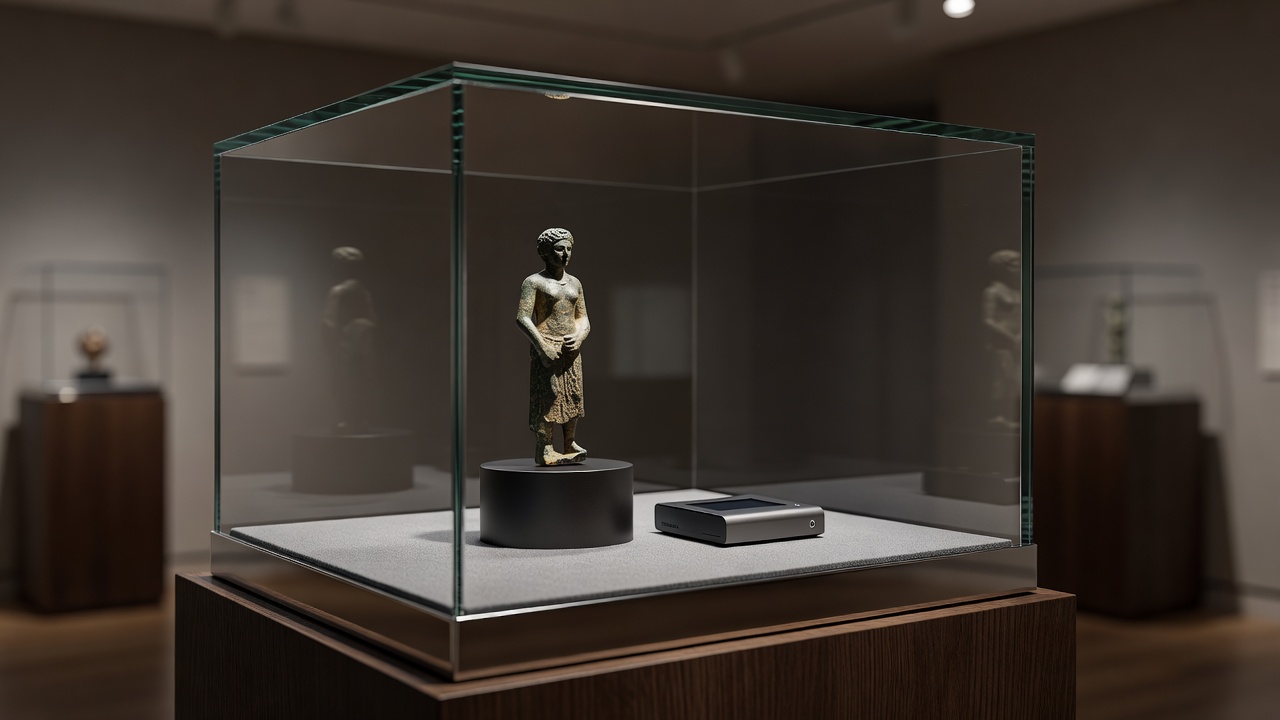
Imagine a wooden object in a glazed cabinet beside an external wall. A logger at the gallery entrance may be functioning perfectly and still miss the conditions that matter inside that cabinet. Before buying equipment, write down what you need to know. Is the enclosure buffering daily changes? Does lighting warm its upper shelf? Does opening the door disturb a previously stable environment? A question gives every measurement a purpose.
Distinguish a broad survey from a focused investigation. A survey identifies patterns across rooms, elevations and seasons. An investigation follows a suspected risk near a particular object or enclosure. You may need both, but they should not be mistaken for one another. A single convenient position is rarely a complete description of a complex space.
Build a comparison that can be interpreted
A useful starting arrangement pairs a representative room sensor with a sensor inside the enclosure under study. Record their distance from external walls, lights, air supplies, doors and glazing. Include shelf height and whether the sensing element sits behind an obstruction. A photograph and a simple annotated plan often preserve context more effectively than an informal label such as “gallery corner.”
Keep instruments secure and reversible. Do not rest a logger on an object, pass a cable across a fragile surface or introduce an unassessed adhesive into a case. Sensor housings, batteries and mounts also deserve consideration as materials entering a collection environment. Coordinate access with conservation, collections and facilities staff rather than treating installation as a purely technical task.
Understand what the instrument actually measures
Most compact climate loggers combine an electronic temperature sensor with a capacitive relative-humidity element. The latter detects changes in an absorbent dielectric material and converts them into a humidity estimate. Manufacturer specifications describe performance under stated conditions; they do not guarantee equal performance after contamination, condensation or years of use. Resolution on a display is not the same as accuracy.
Check the expected measurement range, uncertainty, response time and calibration information before deployment. Placing instruments together for a comparison can reveal disagreement, but agreement alone does not establish traceability. Calibration compares an instrument with a reference under controlled conditions. Adjustment changes its response. Verification checks whether it meets an agreed requirement. Keep these activities distinct in your records.
Choose an interval that fits the question
A short recording interval can reveal door-opening events but increases data volume and may reduce battery life. A longer interval can describe seasonal behaviour while missing brief excursions. As an illustrative exercise, compare a series recorded every five minutes with the same series reduced to hourly values. The smoother line is not necessarily a truer description of the object's experience. Neither interval is a universal recommendation.
Synchronise clocks, record the time zone and note daylight-saving changes. Check whether exported values are instantaneous samples or averages. Wireless systems may store measurements locally during a network interruption, or they may lose them; confirm which applies. Missing transmissions, depleted batteries and a genuinely steady environment can all produce deceptively uneventful charts.
Keep a history of the measurement
Assign each instrument a persistent identifier. Retain its calibration history, deployment dates, firmware changes, moves and battery replacements. Record case openings, cleaning, exhibitions and building work alongside the environmental series. A sensor moved from a room into a case without an annotation creates an apparent climate change that is actually a change in the measurement location.
Review the installation after a suitable observation period. Compare paired traces, inspect gaps and ask whether the original question has been answered. A pilot deployment often exposes practical problems before an entire network is purchased. Monitoring becomes valuable when someone has responsibility for looking, interpreting and acting—not simply when a dashboard begins to populate.
At the reading desk: useful starting references
The Canadian Conservation Institute offers preventive conservation guidance, including its Agents of Deterioration resources. The Collections Trust Spectrum standard provides a framework for collection procedures and documentation. EN 15758 addresses procedures and instruments for measuring air and surface temperatures in cultural heritage environments. Consult current editions and assess their scope before applying them.
Canadian Conservation Institute · Collections Trust Spectrum