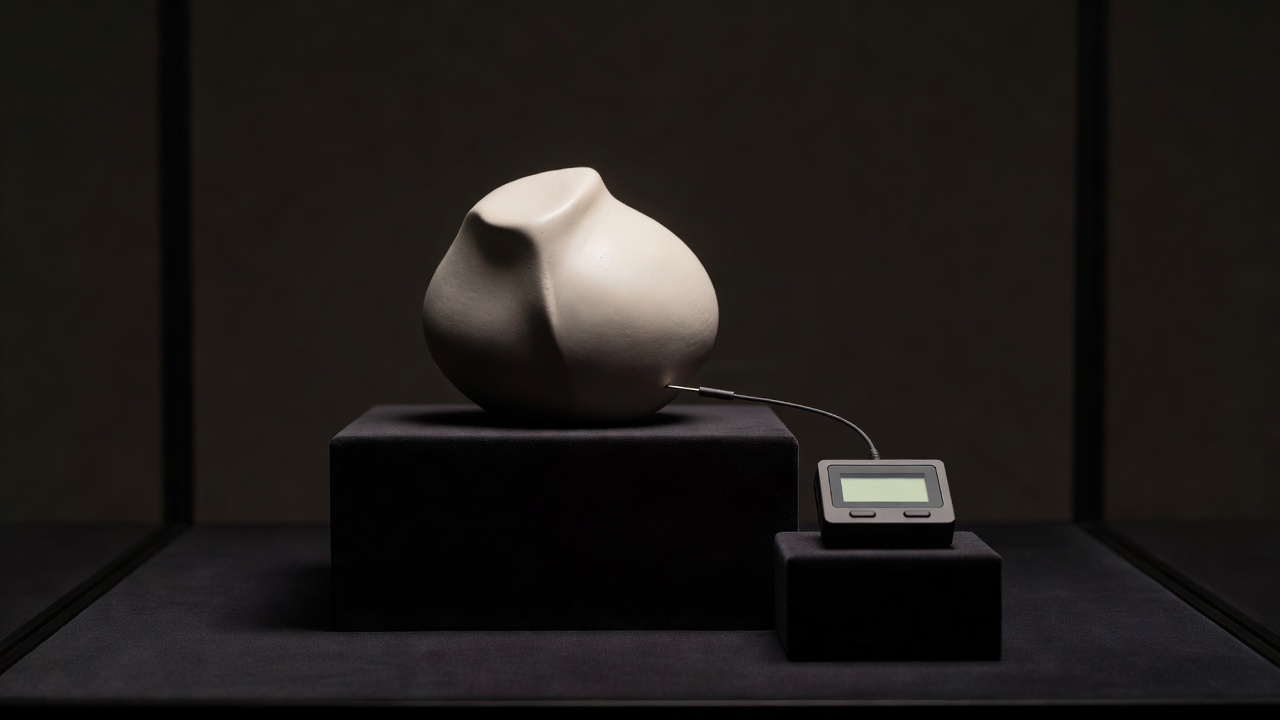
Air and object are different subjects
A temperature logger usually measures the temperature of its own sensing element as that element exchanges heat with its surroundings. In a well-chosen position, it can approximate local air temperature. Under a lamp, beside a cold wall or inside a poorly ventilated housing, radiation and restricted airflow may influence the result. “Air temperature” is therefore a claim that depends partly on placement and instrument design.
An object's surface can differ from the adjacent air. Sunlight may warm a dark surface while a substantial stone object remains cool after the room has warmed. Thick materials have thermal inertia, so they respond slowly. A logger at the door of a store does not establish the temperature within a packed crate, and a surface reading does not reveal the temperature throughout an object.
Choose a sensor for the measurement
Thermistors are widely used in compact loggers because their electrical resistance changes strongly with temperature. Platinum resistance thermometers can offer stable, well-characterised performance in suitable measurement systems. Thermocouples are useful across broad ranges and in specialised investigations, but the complete system and its reference-junction compensation affect accuracy. None of these technologies removes the need for calibration and thoughtful installation.
Infrared instruments estimate surface temperature from emitted radiation rather than measuring air. Their readings depend on emissivity, reflected surroundings, viewing geometry and spot size. Shiny metal and glass can be particularly misleading. A thermal camera is an investigative aid, not a direct map of collection risk. Contact probes also require conservation approval: attaching a probe can damage a surface or change the very conditions being studied.
Follow the daily rhythm
Plot temperature against lighting hours, occupancy and heating or ventilation schedules. A repeating rise after lights switch on suggests a different cause from a slow seasonal drift. Compare a case sensor with a room reference, taking account of their response times. If one instrument responds more slowly, an apparent time delay may belong partly to the measurement system rather than entirely to the enclosure.
Consider an illustrative case that reads 20 °C before opening and 23 °C during a lit afternoon. These values are not recommended conditions or evidence of damage. The useful questions are what caused the change, how long it persisted, how RH behaved and whether the object's materials are sensitive to that pattern. Preserve the full trace rather than reducing the episode to a single maximum.
| Observation | Possible explanation | Next check |
|---|---|---|
| Case warms during opening hours | Lighting, occupancy or room operation | Compare lighting records and a shaded room reference |
| Surface appears colder than room air | Thermal lag or a cold boundary | Assess the measurement method and local dew point |
| RH falls as temperature rises | Temperature-driven RH change | Review paired data and water-vapour indicators |
| Isolated abrupt temperature jump | Handling, relocation or local heat source | Check installation and event records |
Temperature changes the moisture picture
When air is cooled without removing water vapour, its RH rises. A sufficiently cold surface may reach the dew point, allowing condensation. A room sensor some distance away may not reveal the highest RH at that surface. This is one reason to investigate external walls, thermal bridges and the backs of enclosed displays when local dampness is suspected.
Conversely, warming air can lower RH without removing moisture. Raising the temperature to reduce a displayed RH value may therefore leave the moisture source unresolved. It can also change collection risks or occupant comfort. Treat temperature and humidity as connected evidence, not two independent targets to be corrected separately whenever a dashboard changes colour.
Think in material timescales
Temperature influences many chemical deterioration processes, but the relationship varies with material, moisture and mechanism. Some photographic and film collections benefit from carefully managed cool or cold storage. That does not justify placing mixed collections in an ordinary refrigerator. Packaging, humidity control, access procedures and acclimatisation require specialist planning to avoid condensation and handling problems.
A proportionate response might involve reducing unnecessary local heating, reviewing lamp placement or improving an enclosure before changing the whole building. Consult facilities staff when considering operational changes. Record the intervention and check its effect over a meaningful period. The goal is not a perfectly straight line; it is an understood and manageable environment around the collection.
Reading notes: thermal measurement and preservation
EN 15758 covers measurement of air and surface temperatures in cultural heritage settings. ASHRAE publishes guidance for museums, galleries, archives and libraries within its applications material; use the current relevant edition and its risk context. The Image Permanence Institute provides resources on preservation environments and media stability. The National Park Service Museum Handbook is another substantial practical reference.
ASHRAE · Image Permanence Institute · National Park Service Museum Handbook